
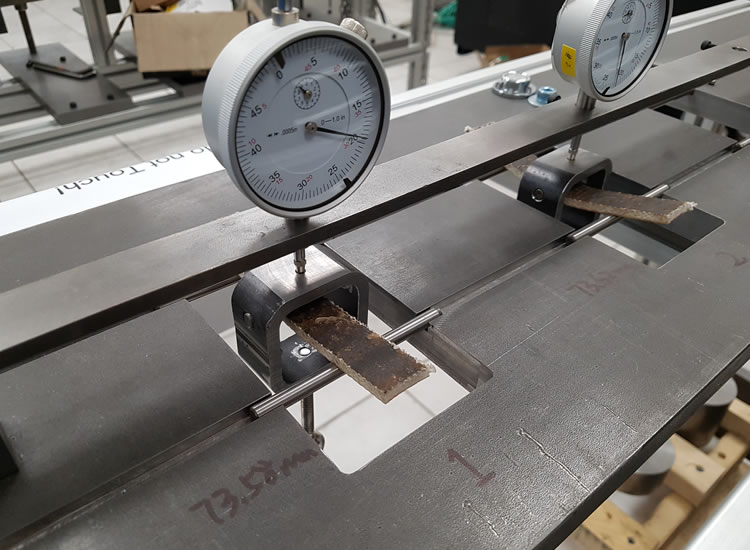
Why do we do long-term creep testing?
The reason cured-in-place-pipe (CIPP) is used as a rehabilitation material is because the user is looking to extend the life of their pipe infrastructure. When plastic materials are stressed they behave differently than metals do. Under typical conditions, when a metal is stressed at a stress less than its yield strength, it will be able to withstand this force indefinitely.
Plastics don’t respond in the same manner. Even when stressed below their yield stress, plastic materials will creep and given sufficient time under load plastics can fail. It’s critical to understand this creep characteristic when designing a CIPP liner installation because we’re looking to extend the life of the deteriorated pipe by at least 50 years.
The flexural creep (ASTM D2990) test setup is very similar to the short-term flexural properties test ASTM D790. A rectangular specimen of the CIPP is placed in simple beam bending but instead of a continuously increasing load as is the case in ASTM D790, a static load is applied instead. Over time, the deflection of this statically loaded beam will increase. The rate of increase will depend on the level of load applied to the specimen.
Multiple specimens are tested simultaneously at a range of loads for up to 10,000 hours. The zero hour loading condition is effectively the same as the short-term flexural modulus. Creep testing is typically carried out at ambient conditions but can also be modified to include the impact of different environmental conditions.
This 10,000 hour deflection/time data is plotted as a log/log relationship and the data is then extrapolated to 50 years. This flexural modulus which is predicted at 50 years then typically forms the basis for the liner design.
So you can see the long term performance is based initially upon the short term modulus. This is why it is critical to establish the short term modulus for each installation since the extent of life extension is directly related to the initial modulus.
Get white papers, updates and event invites straight to your inbox,